Why black paint exposes every swirl and how disciplined, measured correction restores real clarity rather than a temporary fill of gloss.
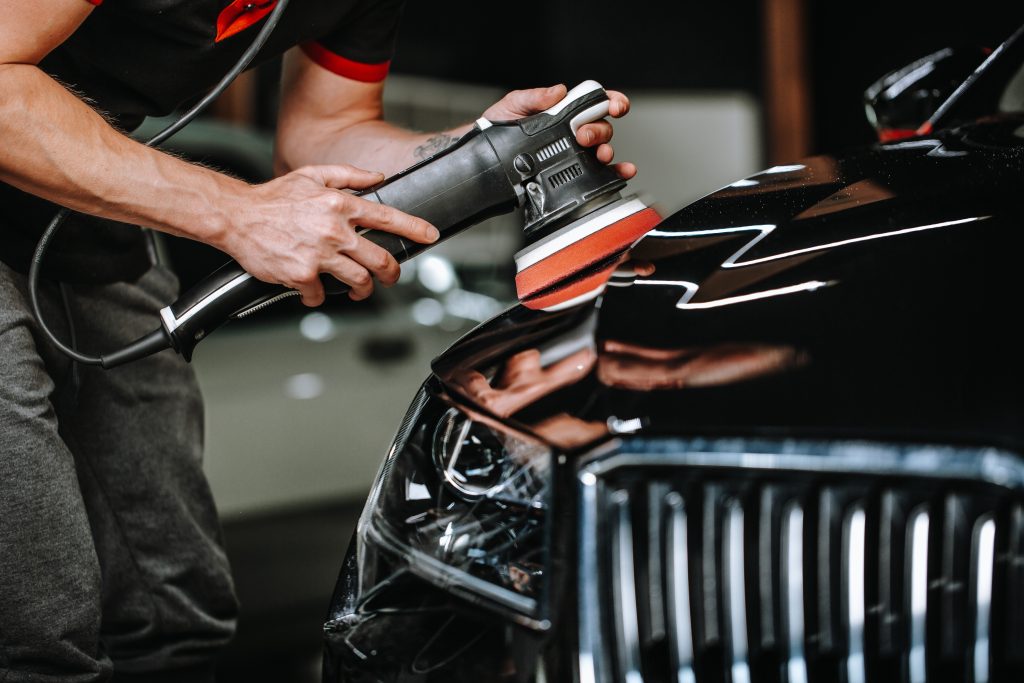
Black is the most honest colour a car can wear. It hides nothing. Under the flat Algarve sun, a black bonnet becomes a mirror, and that mirror shows every swirl, every wash mark, every fine scratch that a silver or white car would quietly conceal. This is why black paint is both the most rewarding and the most demanding surface to correct. The goal of paint correction on black is not simply to make it shine. Gloss is easy. Clarity is hard, and clarity is what separates paint that looks deep and wet from paint that merely looks slick under a showroom light.
The distinction matters because gloss and clarity are not the same thing. A glaze or a filler-heavy polish can drop instant shine into black paint by masking defects with oils that sit in the scratches. It photographs beautifully and it lasts a few weeks. Then the fillers wash out, the sun dries them, and the swirls return exactly as they were. Genuine correction is different: it means levelling a tiny amount of clear coat so that light reflects off a flat surface instead of scattering off thousands of micro-scratches. That is why we lead with clarity. We are removing defects, not hiding them.
Every serious correction starts with measurement, not machine work. Clear coat is finite, often only a few tens of microns thick, and each correction stage removes a few of them permanently. We take paint-thickness readings across the panels, assess the defects under controlled lighting, and only then decide how far to go. On a cherished car, and especially on a resprayed panel or an older repaint, the honest answer is sometimes to correct most of the defects rather than all of them, because chasing the last deep scratch can cost more clear coat than the car can safely give. Preserving paint is part of the craft.
The Algarve adds its own pressure to black paint. Saharan Calima dust settles as a fine, gritty film that turns a careless wipe into a scratch. Coastal salt and sea air near Vale do Lobo and Quinta do Lago keep surfaces damp and reactive. Strong UV steadily hardens and thins the clear coat over the years. None of this is a reason for alarm, but it is a reason for discipline. Much of the swirling we correct on black cars was not caused by the road at all; it was caused by washing, by dry dusting between washes, and by drive-through machines. Correction resets the paint, but how the car is washed afterwards decides how long that reset survives.
That is the trade-off worth being clear about. Paint correction is a reduction of a non-renewable layer, so it is not something to repeat every season. The sensible sequence is to correct the paint properly once, then protect it. A ceramic coating locks in the freshly levelled finish, adds a hydrophobic layer that makes safe washing easier, and buys the clarity time against dust and water spotting. It is worth stating plainly that ceramic is a micron-thin gloss and protection layer; it does not stop stone chips. For a black car that lives on the road, paint protection film on the most vulnerable panels is the physical armour, while correction and coating handle the finish. Many owners end up with a combination, and that is a deliberate choice rather than an upsell.
This is also why we inspect a black car in person before quoting. Two black cars of the same model can need very different work: one may polish out in a single refining stage, another may carry deep swirls, holograms from a previous machine polish, or thin paint that limits what is safe. A fixed price given over a photo would be a guess, and on a finite clear coat a guess is expensive. We look at the paint, measure it, and give a real number for the real condition.
If you own a black car in the golden triangle, the most useful thing you can do between corrections is protect the finish you paid for. Wash with two buckets and a clean mitt, touch the paint as little as possible and only late in the process, and keep the car out of automated brushes. Done that way, a proper correction on black can hold its clarity for years rather than weeks, and the mirror stays a mirror.
If this applies to your car, these pages take you straight to the right service.
The Care Club member discount applies to a fixed, closed list of detailing services, led by paint correction, and not to everything JustCars does.
A paint thickness gauge tells us how much material we have to work with before correction, but it cannot see everything that matters.
A practical guide to how machine paint correction removes swirls and scratches, what it can and cannot fix, and why it matters in the Algarve.